🧠 Mappa mentale e percorso di studio
Un’onda è una perturbazione che si propaga nello spazio trasportando energia ma non materia. Le onde sono ovunque: il suono, la luce, le onde sismiche, le onde radio, le increspature sull’acqua. Questo capitolo costruisce il linguaggio comune di tutti i fenomeni ondulatori — ampiezza, lunghezza d’onda, frequenza, velocità — e poi lo applica alla sovrapposizione (interferenza, diffrazione, battimenti), alle onde stazionarie, all’effetto Doppler e infine all’ottica geometrica, dove la luce viene trattata come un fascio di raggi (specchi, lenti, strumenti ottici, dispersione e arcobaleno).
Sezioni
- Onde meccaniche: definizioni
- Onda armonica
- Principio di sovrapposizione
- Onde stazionarie
- Effetto Doppler
- Ottica geometrica
- Cannocchiale e microscopio
- Dispersione, prisma, arcobaleno
Riflessioni
Esercizi
A wave is a disturbance that propagates through space carrying energy but not matter. Waves are everywhere: sound, light, seismic waves, radio waves, ripples on water. This chapter builds the common language of all wave phenomena — amplitude, wavelength, frequency, speed — and then applies it to superposition (interference, diffraction, beats), standing waves, the Doppler effect, and finally geometric optics, where light is treated as a bundle of rays (mirrors, lenses, optical instruments, dispersion and the rainbow).
Sections
- Mechanical waves: definitions
- Harmonic wave
- Superposition principle
- Standing waves
- Doppler effect
- Geometric optics
- Telescope and microscope
- Dispersion, prism, rainbow
Reflections
Exercises
Partiamo dalla definizione: un’onda è una perturbazione che si propaga nello spazio trasportando energia ma non materia. Questa distinzione è il cuore di tutto ciò che segue: quando un’onda attraversa un mezzo, ogni pezzetto del mezzo oscilla attorno alla propria posizione di equilibrio e poi vi ritorna, mentre ciò che davvero viaggia — spostandosi anche a grande distanza — è il disturbo, e con esso l’energia che porta con sé. Le onde sono ovunque: il suono, la luce, le onde sismiche, le onde radio, e perfino le increspature sulla superficie dell’acqua.
Un’onda meccanica è una perturbazione che si propaga in un mezzo materiale (una corda, l’aria, l’acqua, la roccia). A differenza delle onde elettromagnetiche, un’onda meccanica ha bisogno di un mezzo in cui esistere: nel vuoto non può propagarsi. Le onde meccaniche si distinguono in base alla direzione in cui oscilla il mezzo rispetto alla direzione in cui l’onda avanza.
Principio — Trasversale vs longitudinale
- Onda trasversale: la perturbazione è perpendicolare alla direzione di propagazione. Esempi: l’onda su una corda tesa, le onde elettromagnetiche.
- Onda longitudinale: la perturbazione è parallela alla direzione di propagazione. Esempio tipico: il suono, fatto di compressioni e rarefazioni dell’aria lungo la stessa direzione in cui il suono viaggia.
Polarizzazione
Le onde trasversali possono essere polarizzate: la perturbazione oscilla in un unico piano ben definito. Le onde longitudinali, invece, oscillano necessariamente lungo la direzione di propagazione e quindi non possono essere polarizzate. È proprio questa proprietà che permette, per esempio, di riconoscere la luce come onda trasversale.
Il suono
Il suono è un’onda meccanica longitudinale: compressioni e rarefazioni dell’aria (o di un liquido, o di un solido) che si propagano dalla sorgente all’orecchio. Nell’aria a temperatura ambiente viaggia a circa m/s.
Altezza, intensità, timbro — e i suoni che non sentiamo
Tre caratteristiche distinguono un suono da un altro:
- Altezza: dipende dalla frequenza . Frequenza alta = suono acuto, frequenza bassa = suono grave. Il la del diapason ha Hz.
- Intensità (il «volume»): dipende dall’ampiezza dell’onda, cioè da quanta energia trasporta. Si misura in W/m² o, più comodamente, in decibel (vedi sotto).
- Timbro: è ciò che distingue un violino da un flauto che suonano la stessa nota. Un suono reale non è una sola sinusoide, ma la somma della frequenza fondamentale e dei suoi armonici , , …: il timbro dipende da quanto pesa ciascun armonico.
L’orecchio umano sente, all’incirca, da Hz a Hz (il limite alto cala con l’età). Sotto i Hz ci sono gli infrasuoni: li producono i terremoti e le eruzioni, e gli elefanti li usano per comunicare a chilometri di distanza. Sopra i kHz ci sono gli ultrasuoni: i pipistrelli li emettono e ne ascoltano l’eco per orientarsi, le navi li usano nel sonar e i medici nell’ecografia.
Intensità sonora e livello in decibel
L’intensità di un’onda sonora è la potenza che attraversa un’area unitaria perpendicolare alla propagazione, in W/m². L’orecchio copre un intervallo enorme di intensità, da W/m² (soglia di udibilità) a circa W/m² (soglia del dolore, circa – dB, varia con la persona e la frequenza): un fattore mille miliardi. Per questo si usa una scala logaritmica, il livello di intensità sonora:
- → dB (soglia di udibilità);
- W/m² → dB (soglia del dolore);
- ogni volta che l’intensità raddoppia, aumenta di circa dB; ogni volta che si moltiplica per , aumenta di dB.
Ordini di grandezza: un bisbiglio è intorno ai – dB, una conversazione intorno ai dB, il traffico intenso intorno agli – dB, un concerto rock può superare i dB.
Esempio. Un suono ha W/m². Allora dB. Due sorgenti uguali da dB insieme danno , cioè dB, non dB.
Velocità del suono e temperatura
Il valore “circa m/s” vale a temperatura ambiente: nell’aria la velocità del suono cresce con la temperatura. Una formula pratica, con in °C e in m/s, è Quindi a C il suono viaggia a circa m/s, a C a circa m/s, a C a circa m/s.
Perché. Il suono si propaga perché le molecole urtano le vicine e si passano la compressione. Nel modello del gas ideale la velocità quadratica media delle molecole cresce con la temperatura assoluta (), e la velocità del suono è dello stesso ordine e cresce allo stesso modo: . In formula, : dipende da e non dalla pressione. Vista dal lato del mezzo: a pressione costante l’aria più calda è meno densa, quindi più “leggera” da mettere in movimento. La formula lineare è l’approssimazione di per le temperature di tutti i giorni. Una conseguenza: di notte, con l’aria fredda vicino al suolo, il suono si incurva verso il basso e si sentono rumori lontani (problema).
Prova tu — simulazione interattiva

Collegamenti
Argomenti: Onde
Esercizi collegati: Esercizio svolto — Il ciclista e lo specchio acustico · Problema — Ecografia lunghezza d’onda degli ultrasuoni · Problema — Doppler radar e velocità dell’auto
We start from the definition: a wave is a disturbance that propagates through space carrying energy but not matter. This distinction is at the heart of everything that follows: when a wave passes through a medium, each little piece of the medium oscillates about its own equilibrium position and then returns to it, while what truly travels — moving even over great distances — is the disturbance, and with it the energy it carries. Waves are everywhere: sound, light, seismic waves, radio waves, and even ripples on the surface of water.
A mechanical wave is a disturbance that propagates in a material medium (a string, air, water, rock). Unlike electromagnetic waves, a mechanical wave needs a medium in which to exist: it cannot propagate in a vacuum. Mechanical waves are distinguished by the direction in which the medium oscillates relative to the direction in which the wave advances.
Principle — Transverse vs longitudinal
- Transverse wave: the disturbance is perpendicular to the direction of propagation. Examples: the wave on a taut string, electromagnetic waves.
- Longitudinal wave: the disturbance is parallel to the direction of propagation. Typical example: sound, made up of compressions and rarefactions of the air along the same direction in which the sound travels.
Polarisation
Transverse waves can be polarised: the disturbance oscillates in a single well-defined plane. Longitudinal waves, on the other hand, necessarily oscillate along the direction of propagation and therefore cannot be polarised. It is precisely this property that allows, for example, light to be recognised as a transverse wave.
Sound
Sound is a longitudinal mechanical wave: compressions and rarefactions of air (or of a liquid, or a solid) travelling from the source to the ear. In air at room temperature it travels at about m/s.
Pitch, loudness, timbre — and the sounds we cannot hear
Three features tell one sound from another:
- Pitch: set by the frequency . High frequency = high-pitched sound, low frequency = low-pitched. A tuning fork’s A has Hz.
- Loudness (intensity): set by the wave’s amplitude, i.e. by how much energy it carries. Measured in W/m² or, more conveniently, in decibels (see below).
- Timbre: what makes a violin sound different from a flute playing the same note. A real sound is not a single sine wave but the sum of the fundamental frequency and its harmonics , , …: timbre depends on how much each harmonic weighs.
The human ear hears roughly from Hz to Hz (the upper limit drops with age). Below Hz lies infrasound: earthquakes and eruptions produce it, and elephants use it to communicate over kilometres. Above kHz lies ultrasound: bats emit it and listen to the echo to find their way, ships use it in sonar, doctors in ultrasound imaging.
Sound intensity and level in decibels
The intensity of a sound wave is the power crossing a unit area perpendicular to the propagation, in W/m². The ear covers a huge range, from W/m² (threshold of hearing) to about W/m² (threshold of pain, roughly – dB, varying with the listener and the frequency): a factor of a trillion. That is why a logarithmic scale is used, the sound intensity level:
- → dB (threshold of hearing);
- W/m² → dB (threshold of pain);
- each time the intensity doubles, rises by about dB; each factor of adds dB.
Orders of magnitude: a whisper is around – dB, a conversation around dB, heavy traffic around – dB, a rock concert can exceed dB.
Example. A sound has W/m². Then dB. Two identical dB sources together give , i.e. dB, not dB.
Speed of sound and temperature
The value “about m/s” holds at room temperature: in air the speed of sound increases with temperature. A practical formula, with in °C and in m/s, is So at C sound travels at about m/s, at C at about m/s, at C at about m/s.
Why. Sound propagates because molecules collide with their neighbours and pass the compression on. In the ideal-gas model the root-mean-square speed of the molecules grows with the absolute temperature (), and the speed of sound is of the same order and grows in the same way: . In formula, : it depends on and not on pressure. Seen from the medium’s side: at constant pressure warmer air is less dense, so “lighter” to set in motion. The linear formula is the approximation of for everyday temperatures. One consequence: at night, with cold air near the ground, sound bends downwards and distant noises can be heard (problem).
Try it — interactive simulation
Links
Topics: Waves
Related exercises: Worked exercise — The cyclist and the acoustic mirror · Problem — Ultrasound wavelength in an ultrasound scan · Problem — Doppler radar and the car’s speed
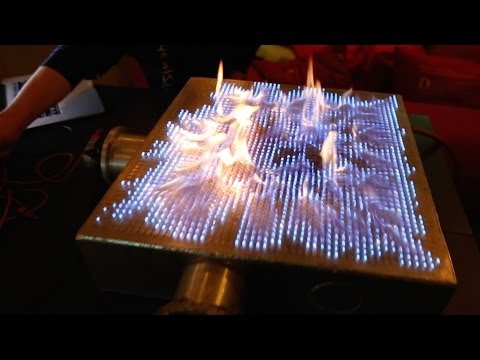
Quando un’onda si riflette contro un estremo fisso, l’onda incidente e quella riflessa viaggiano in versi opposti e si sovrappongono. Se le condizioni sono giuste, il risultato non sembra più propagarsi: è un’onda stazionaria. Alcuni punti, i nodi, restano sempre fermi; altri, i ventri, oscillano con ampiezza massima. La figura non corre lungo il mezzo, ma vibra sul posto, come la corda di una chitarra pizzicata.
Onde stazionarie su una corda fissata ai due estremi: le prime tre armoniche (). I punti rossi sono i nodi (ampiezza zero).
Non tutte le lunghezze d’onda possono formare un’onda stazionaria: solo quelle che “entrano” un numero intero di volte nel mezzo, rispettando i vincoli agli estremi. Ne segue che il sistema può vibrare soltanto a un insieme discreto di frequenze di risonanza, le sue armoniche. È questo il motivo per cui una corda di lunghezza fissa emette note ben definite.
Formula chiave — Frequenze di risonanza
Corda fissata a entrambi gli estremi (lunghezza ), oppure tubo aperto-aperto: Tubo aperto a un estremo e chiuso all’altro (solo armoniche dispari):
La frequenza più bassa () è la fondamentale e determina l’altezza della nota; le altre sono i suoi armonici, che ne arricchiscono il timbro. Si noti la differenza fra i due casi: la corda (e il tubo aperto-aperto) contiene tutte le armoniche, mentre il tubo chiuso-aperto ne contiene solo le dispari — ed è per questo che un clarinetto (tubo chiuso a un capo) suona diverso da un flauto (tubo aperto) di pari lunghezza.
Note
Nella corda fissa gli estremi sono nodi obbligati (non possono muoversi); in un’estremità aperta di un tubo l’aria è libera di oscillare, quindi lì c’è un ventre. È questa asimmetria fra estremo chiuso e aperto a dimezzare la frequenza fondamentale e a eliminare le armoniche pari nel tubo chiuso-aperto.

Collegamenti
Argomenti: Onde Concetti: Onde stazionarie · Periodo e frequenza
Esercizi collegati: Problema — Ecografia lunghezza d’onda degli ultrasuoni · Problema — Perché il tuono arriva dopo il lampo · Problema — Lettura di lambda e T da un grafico d’onda
When a wave reflects off a fixed end, the incident wave and the reflected wave travel in opposite directions and overlap. If the conditions are right, the result no longer appears to propagate: it is a standing wave. Some points, the nodes, remain always still; others, the antinodes, oscillate with maximum amplitude. The figure does not run along the medium, but vibrates in place, like the string of a plucked guitar.
Standing waves on a string fixed at both ends: the first three harmonics (). The red dots are the nodes (zero amplitude).
Not every wavelength can form a standing wave: only those that “fit” a whole number of times into the medium, respecting the constraints at the ends. It follows that the system can vibrate only at a discrete set of resonance frequencies, its harmonics. This is the reason a string of fixed length emits well-defined notes.
Key formula — Resonance frequencies
String fixed at both ends (length ), or open–open tube: Tube open at one end and closed at the other (only odd harmonics):
The lowest frequency () is the fundamental and determines the pitch of the note; the others are its harmonics, which enrich its timbre. Note the difference between the two cases: the string (and the open–open tube) contains all the harmonics, while the closed–open tube contains only the odd ones — which is why a clarinet (a tube closed at one end) sounds different from a flute (an open tube) of equal length.
Note
In the fixed string the ends are compulsory nodes (they cannot move); at the open end of a tube the air is free to oscillate, so there is an antinode there. It is this asymmetry between the closed and open ends that halves the fundamental frequency and eliminates the even harmonics in the closed–open tube.
Links
Topics: Waves Concepts: Standing waves · Period and frequency
Related exercises: Problem — Ultrasound wavelength in an ultrasound scan · Problem — Why thunder arrives after lightning · Problem — Reading lambda and T from a wave graph
Quando una sorgente di onde e un osservatore sono in moto relativo, la frequenza percepita non è più quella emessa: è l’effetto Doppler. Se sorgente e ricevitore si avvicinano, i fronti d’onda arrivano più fitti e la frequenza percepita cresce; se si allontanano, i fronti si diradano e la frequenza cala. Lo si sente ogni volta che un’ambulanza passa: la sirena è più acuta mentre si avvicina, più grave appena ci ha superato.
Effetto Doppler: quando la sorgente si muove, i fronti d’onda si comprimono davanti (frequenza più alta) e si dilatano dietro (frequenza più bassa).
Formula chiave — Legge dell'effetto Doppler
dove è la velocità dell’onda nel mezzo, la velocità della sorgente (emettitore) e la velocità del ricevitore. Le velocità sono positive nel verso sorgente ricevitore.
Convenzione dei segni
Se la sorgente si avvicina al ricevitore: , il denominatore diminuisce e aumenta. Se il ricevitore si allontana: , il numeratore diminuisce e cala. Sbagliare un segno inverte l’effetto: conviene sempre controllare che il risultato abbia il verso giusto (avvicinamento suono più acuto).
Approfondimento — Sorgente supersonica e cono di Mach
Che cosa succede se la sorgente va più veloce del suono? Usiamo gli stessi simboli della formula di Doppler qui sopra:
- la velocità del suono nel mezzo (nell’aria, circa );
- la velocità della sorgente rispetto al mezzo;
- la semiapertura del cono, cioè l’angolo fra la direzione del moto della sorgente e la superficie del cono.
Costruzione dei fronti d’onda. Un fronte emesso un tempo fa è una sfera di raggio , centrata nel punto in cui si trovava allora la sorgente; nel frattempo la sorgente ha percorso il tratto . Se , la sorgente sta sempre davanti a tutti i fronti che ha emesso: le sfere non si annidano più l’una dentro l’altra, ma si accavallano lungo una superficie comune, l’inviluppo, che ha la forma di un cono con il vertice nella sorgente: il cono di Mach. Davanti al cono non arriva ancora nessun suono.
Nel triangolo rettangolo che ha per ipotenusa il tratto percorso dalla sorgente () e per cateto il raggio del fronte (), l’angolo opposto al cateto è proprio : dove il numero di Mach è il rapporto (numero puro) fra la velocità della sorgente e quella del suono: Il cono esiste solo per ; più la sorgente è veloce, più il cono è stretto. Per si ha : i fronti si accumulano tutti davanti alla sorgente, formando il “muro del suono”.
Boom sonico. Sulla superficie del cono si sommano i contributi di moltissimi fronti: lì c’è un brusco salto di pressione, un’onda d’urto. Quando il cono, che viaggia con l’aereo, passa sopra un osservatore a terra, questi sente un colpo secco, il boom sonico. Il boom non avviene una volta sola, nell’istante in cui l’aereo “supera il muro del suono”: l’aereo se lo trascina dietro per tutto il tempo in cui vola a velocità supersonica, e ogni punto del terreno lo sente quando viene raggiunto dal cono. Lo stesso fenomeno spiega lo schiocco di una frusta, la cui punta supera la velocità del suono. Qualcosa di simile, ma non identico, è la scia a V di una barca: le onde sull’acqua hanno una velocità che dipende dalla loro lunghezza d’onda, e la scia ha una semiapertura di circa (apertura totale ), quasi indipendente dalla velocità della barca.
Sorgente supersonica con : i fronti emessi nel passato (cerchi blu) sono tutti dietro alla sorgente e il loro inviluppo è il cono di Mach (in rosso), di semiapertura .
Testo
Un aereo vola in orizzontale a Mach 2 alla quota , in aria dove la velocità del suono è . Calcola: (a) la velocità dell’aereo; (b) la semiapertura del cono di Mach; (c) quanto tempo dopo essere passato esattamente sopra la testa di un osservatore a terra l’osservatore sente il boom (trascura la variazione della velocità del suono con la quota).
Soluzione
(a) Dalla definizione del numero di Mach: (b) (c) Nell’istante in cui l’aereo è sulla verticale dell’osservatore, il cono è ancora dietro di lui: l’osservatore non sente nulla. Il cono lo raggiunge quando l’aereo ha percorso un tratto orizzontale tale che la superficie del cono, inclinata di rispetto alla traiettoria, passi per l’osservatore: Il tempo impiegato dall’aereo per percorrere questo tratto è L’osservatore sente il boom circa dopo aver visto l’aereo sopra di sé, quando l’aereo è ormai a più di di distanza in orizzontale. Controllo: in quel momento la distanza aereo–osservatore è , perché in un triangolo con un angolo di l’ipotenusa è il doppio del cateto opposto.
Curiosità — Sirene e stelle
Il Doppler acustico spiega perché il suono di un’ambulanza è più acuto quando si avvicina e più grave quando si allontana. In astrofisica, il redshift (spostamento verso il rosso) della luce delle galassie lontane — scoperto da Hubble nel 1929 — è l’analogo ottico dello stesso effetto: dimostra che quelle galassie si allontanano da noi e che l’universo si sta espandendo.

Collegamenti
Argomenti: Onde Concetti: Effetto Doppler
Esercizi collegati: Esercizio svolto — Il ciclista e lo specchio acustico · Problema — Doppler radar e velocità dell’auto · Problema — Doppler ambulanza in avvicinamento
When a source of waves and an observer are in relative motion, the perceived frequency is no longer the emitted one: this is the Doppler effect. If source and receiver approach each other, the wavefronts arrive more closely spaced and the perceived frequency rises; if they move apart, the wavefronts spread out and the frequency falls. You hear it every time an ambulance passes: the siren is higher-pitched as it approaches, lower as soon as it has passed.
Doppler effect: when the source moves, the wavefronts bunch up ahead (higher frequency) and spread out behind (lower frequency).
Key formula — Doppler effect law
where is the speed of the wave in the medium, the speed of the source (emitter) and the speed of the receiver. Velocities are positive in the source receiver direction.
Sign convention
If the source approaches the receiver: , the denominator decreases and increases. If the receiver moves away: , the numerator decreases and falls. Getting a sign wrong reverses the effect: it’s always worth checking the result has the right sense (approaching higher-pitched sound).
Further reading — Supersonic source and the Mach cone
What happens if the source moves faster than sound? We use the same symbols as the Doppler formula above:
- the speed of sound in the medium (in air, about );
- the speed of the source relative to the medium;
- the half-angle of the cone, i.e. the angle between the direction of motion of the source and the surface of the cone.
Building the wavefronts. A wavefront emitted a time ago is a sphere of radius , centred on the point where the source was at that moment; meanwhile the source has covered the distance . If , the source is always ahead of all the wavefronts it has emitted: the spheres no longer nest inside one another, but pile up along a common surface, the envelope, which has the shape of a cone with its vertex at the source: the Mach cone. No sound has yet reached the region in front of the cone.
In the right triangle whose hypotenuse is the distance covered by the source () and whose leg is the radius of the wavefront (), the angle opposite that leg is exactly : where the Mach number is the ratio (a pure number) between the speed of the source and the speed of sound: The cone exists only for ; the faster the source, the narrower the cone. For we get : all the wavefronts pile up in front of the source, forming the “sound barrier”.
Sonic boom. On the surface of the cone the contributions of a great many wavefronts add up: there is a sudden jump in pressure there, a shock wave. When the cone, which travels with the aircraft, sweeps over an observer on the ground, they hear a sharp bang, the sonic boom. The boom does not happen just once, at the instant the aircraft “breaks the sound barrier”: the aircraft drags it along for as long as it flies at supersonic speed, and every point on the ground hears it when the cone reaches it. The same phenomenon explains the crack of a whip, whose tip exceeds the speed of sound. Something similar, but not identical, is the V-shaped wake of a boat: waves on water have a speed that depends on their wavelength, and the wake has a half-angle of about (total opening ), almost independent of the boat’s speed.
Supersonic source with : the wavefronts emitted in the past (blue circles) are all behind the source, and their envelope is the Mach cone (in red), with half-angle .
Problem
An aircraft flies horizontally at Mach 2 at an altitude , in air where the speed of sound is . Calculate: (a) the speed of the aircraft; (b) the half-angle of the Mach cone; (c) how long after passing exactly overhead an observer on the ground hears the boom (neglect the variation of the speed of sound with altitude).
Solution
(a) From the definition of the Mach number: (b) (c) At the instant the aircraft is directly above the observer, the cone is still behind it: the observer hears nothing. The cone reaches the observer when the aircraft has covered a horizontal distance such that the surface of the cone, inclined at to the flight path, passes through the observer: The time the aircraft takes to cover this distance is The observer hears the boom about after seeing the aircraft overhead, when it is already more than away horizontally. Check: at that moment the aircraft–observer distance is , because in a triangle with a angle the hypotenuse is twice the opposite leg.
Curiosity — Sirens and stars
The acoustic Doppler effect explains why the sound of an ambulance is higher-pitched as it approaches and lower as it moves away. In astrophysics, the redshift of light from distant galaxies — discovered by Hubble in 1929 — is the optical analogue of the same effect: it shows that those galaxies are moving away from us and that the universe is expanding.
Links
Topics: Waves Concepts: Doppler effect
Related exercises: Worked exercise — The cyclist and the acoustic mirror · Problem — Doppler radar and the car’s speed · Problem — Doppler, ambulance approaching
Il mezzo non si sposta: si sposta il disturbo
Una delle confusioni più comuni sulle onde è credere che “qualcosa vada da A a B”. In realtà, in un’onda sul mare, l’acqua non viaggia con l’onda: ogni punto della superficie compie piccole oscillazioni verticali, ed è lo stato di oscillazione a propagarsi da un punto all’altro. Il tappo di sughero non raggiunge mai la riva: oscilla su e giù mentre le onde gli passano sotto. Questa osservazione ha implicazioni profonde: le onde trasportano energia e quantità di moto senza trasportare materia. Ed è proprio per questo che possono attraversare lo spazio vuoto (le onde elettromagnetiche) o essere usate per trasmettere informazione (suoni, radio, luce): il segnale viaggia, ma il mezzo resta mediamente fermo.
Collegamenti
Argomenti: Onde Concetti: Onda armonica
Esercizi collegati: Problema — Analisi dimensionale velocità su una corda · Problema — Vero o falso su onde e Doppler · Cosa trasporta un’onda (la foglia)
The medium does not move: the disturbance does
One of the most common confusions about waves is believing that “something goes from A to B”. In reality, in a wave on the sea, the water does not travel with the wave: every point on the surface performs small vertical oscillations, and it is the state of oscillation that propagates from one point to the next. The cork never reaches the shore: it bobs up and down as the waves pass beneath it. This observation has profound implications: waves carry energy and momentum without carrying matter. And it is precisely for this reason that they can cross empty space (electromagnetic waves) or be used to transmit information (sound, radio, light): the signal travels, but the medium remains on average still.
Links
Topics: Waves Concepts: Harmonic wave
Related exercises: Problem — Dimensional analysis of the speed on a string · Problem — True or false on waves and Doppler · What a wave carries (the leaf)
Onde: stesso oggetto, mille travestimenti
Le onde, in fisica, sono uno dei concetti più trasversali che esistano. Lo stesso impianto matematico — velocità di propagazione, lunghezza d’onda, frequenza, principio di sovrapposizione, riflessione, rifrazione, diffrazione, effetto Doppler — descrive fenomeni di natura così diversi che a prima vista non parrebbero parenti: il pizzicare di una corda di chitarra, il propagarsi del suono nell’aria, le onde sismiche che attraversano la Terra, la luce che arriva dal Sole, le onde radio che portano il segnale del cellulare, le onde gravitazionali rivelate da LIGO. Ciò che le accomuna non è la natura del mezzo (in qualche caso non c’è nemmeno un mezzo!) ma la forma matematica del fenomeno: una perturbazione che si propaga conservando la sua identità. Questo è uno degli esempi più eleganti di come la fisica, una volta capito un linguaggio, lo applichi a contesti completamente nuovi: lo studio del suono fatto da Helmholtz nell’Ottocento ha preparato il terreno per quello della radio nel Novecento e per quello dei segnali quantistici nel nostro secolo. Imparare bene le onde è, in un certo senso, imparare un dialetto universale della fisica (Battimelli e Stilli 1999; Feynman, Leighton e Sands 1963).

Collegamenti
Argomenti: Onde
Esercizi collegati: Esercizio svolto — Il ciclista e lo specchio acustico · Problema — Ecografia lunghezza d’onda degli ultrasuoni · Problema — Doppler radar e velocità dell’auto
Waves: same object, a thousand disguises
Waves, in physics, are one of the most transversal concepts there is. The same mathematical apparatus — propagation speed, wavelength, frequency, the superposition principle, reflection, refraction, diffraction, the Doppler effect — describes phenomena of such different nature that at first sight they would not seem related: the plucking of a guitar string, the propagation of sound through air, the seismic waves that cross the Earth, the light arriving from the Sun, the radio waves that carry a mobile phone signal, the gravitational waves detected by LIGO. What they have in common is not the nature of the medium (in some cases there is not even a medium!) but the mathematical form of the phenomenon: a disturbance that propagates while preserving its identity. This is one of the most elegant examples of how physics, once it has understood a language, applies it to entirely new contexts: the study of sound carried out by Helmholtz in the nineteenth century paved the way for that of radio in the twentieth century and for that of quantum signals in our own century. Learning waves well is, in a sense, learning a universal dialect of physics (Battimelli and Stilli 1999; Feynman, Leighton and Sands 1963).
Links
Topics: Waves
Related exercises: Worked exercise — The cyclist and the acoustic mirror · Problem — Ultrasound wavelength in an ultrasound scan · Problem — Doppler radar and the car’s speed